Showing posts with label Life and Death. Show all posts

Wednesday, 24 September 2014

White Tulips for my Mother in Law


My mother in law passed away over the Merdeka weekend. She was 80 years old and had been suffering from Parkinsons disease for the past four years. It  is a degenerative disorder of the central nervous system. Early in the course of the disease, the most obvious symptoms are movement related; these include shaking, rigidity, slowness of movement and difficulty with walking and gait. Later, as the disease became more advanced, she suffered from dementia and depression.

I was not very close to my mother in law. We were from different generations and backgrounds and so differed greatly in our  ways.  I found her difficult to relate with. The irony was that we were both women and  mothers. We shared the same concerns. Why we were unable to focus more on our similarities rather than differences? I guess we were too much alike. We were full of pride. And I was young and lacked the maturity to do it any differently.

It was in her later years, when she fell sick that I tried to reach out to her. She was more vulnerable and her defences were down. Once a very proud woman, she became a different person. I accompanied her on her first few visits to the hospital  when she was diagnosed with Parkinsons disease and tried my best to be a source of help for her. Through it all, I learned that no matter the circumstances, what has transpired and what grievances we hold, treating another person  in a  human and dignified way actually comes very naturally to us. We are capable of putting every grudge aside to be of support to another person. To act otherwise, we have to really close our hearts and act very steely. And I am glad I was present for her when she needed it

To my dear mother in law, wherever you are, I want to say that you were a fashionista, a gutsy, determined lady. I pray that  love, peace  and happiness follow you wherever you are .


Friday, 19 April 2013

Going Home (End of Life Series)


I would like to to thank readers who have written to me here on this blog as well as emailed me recently about my father's condition. He is at home, recuperating. I was happy when my mother told me that he likes my little massages. We are trying to support him, to the best of our capability, as his children.

Ultimately, everyone of us, man or woman walk alone on our journey home. However, this journey can be made more meaningful. if we can also provide support, love and comfort during the transition. Paul McCartney was present with his children when his wife, Linda McCartney passed away after a battle with breast cancer. "The kids and I were there when she crossed over. They each were able to tell her how much they loved her. Finally, I said to her: ''You're up on your beautiful Appaloosa stallion. It's a fine spring day. We're riding through the woods. The bluebells are all out, and the sky is clear blue.'' I had barely got to the end of the sentence, when she closed her eyes, and gently slipped away.

I think most of us would want to die, surrounded by loved ones and familiar faces, if possible. If we can share our lives, why not share the final lap together also?  I would like to pray for the good health of everyone on this planet.. I pray also for all who are sick and suffering.

May suffering ones be suffering free
and the fear-struck fearless be.
May the grieving shed all grief,
and all beings find relief.

Saturday, 13 April 2013

Death - A Celebration of Life (End of Life Series)

I attended a talk by a bereavement care company today. We were spared the sales talk because the organisers, a hospice centre had given them instructions not to use the talk as a sales event. The speaker, a 38 year old man shared that by pre-planning one's own funeral, one's  family will be spared from having to take care of funeral arrangements at a time when they are grieving.  As all related payments would have been made earlier, the children would also be spared of financial  pressure. It is worthwhile considering, just so that those left behind will have an easier time.

He said that he realised how very precious life is, after the unexpected loss of his father. He revealed that his father had died of a sudden heart attack leaving his mother to cope alone, as the children were overseas. He used himself as an example, sharing that he had planned everything, right down to the selection of his photograph, his parting song by Jacky Cheung as well as written his own eulogy.  He wanted his funeral to be a celebration of his life.

Dr Elisabeth Kübler-Ross, was a psychiatrist and the author of the groundbreaking book  "Death and Dying". At the hospital where she worked in New York, she was appalled by the standard treatment of dying patients. “They were shunned and abused, nobody was honest with them”, she said. Unlike her colleagues, she made it a point to sit with terminal patients, listening as they poured out their hearts to her. She began giving lectures featuring dying patients who talked about what they were going through. She also dramatically improved the understanding and practices in relation to bereavement and hospice care. Her ideas, notably the five stages of grief model (denial, anger, bargaining, depression, acceptance), are also transferable to personal change and emotional upset resulting from factors other than death and dying.

I remember my grandmother educating me on  the importance of crying and wailing at the funeral of a loved one. She said that if this is not done, the dead person would be treated badly when they reach hell. From this, I gathered that she wanted the same to be done at her funeral. However, though I was very broken hearted, I did not wail at her funeral. My mother did.

Venerable Ajahn Brahm, in one of his talks on grief said  there is an alternative to grief. Not that grief is wrong, Only that there is another possibility. Loss of a loved one can be viewed in a second way, a way that avoids the long days of aching grief. When his father died, it was as if a great concert had finally come to an end. Though he knew in his heart that he would probably not get to be with him again, he didn’t feel sad; nor did he cry. What he felt in his heart was, “What a magnificent father! What a powerful inspiration was his life. How lucky he was to have been there at the time. How fortunate he was to have been his son. ”I felt the very same exhilaration as I had often felt at the end of one of the great concerts in my life. I wouldn’t have missed that for the world." he said.


Grieving is very much a personal thing.  The way we grieve is very dependent on our personality type and the culture to which we have been exposed.. It does not mean that a person who wails feels more than a person who does not.  The late Jacqueline Kennedy was very much admired because she was regarded as being very dignified in the way she carried herself during the death of her husband, John F Kennedy. My grandmother would have disapproved of her behaviour, though.

There is nothing wrong with grieving just as there is nothing wrong with viewing it as a celebration of life. It is our choice to make. Just choose the route that is most loving and beneficial  to ourselves. I would like to share this poem which I found to be comforting when I was grieving.  Death maybe the end of that life but not the relationship. Death is also not the end of love and loving. I have not stopped loving my late grandmother and former pets. And I believe, neither have they stopped loving me.

I Am Not Gone

Golden Flower Metal Art by Injete Chesoni 
I am not gone
I remain here beside you
Just in a different form
Look for me in your heart
And there you will find me
in our love which forever lives on

In those moments when you feel alone
Look for me in your thoughts
And there you will find me
in sweet memories that burn strong

Every time a tear
Forms in your beautiful eyes
Look up to the heavens
And there you will see me
Smiling down from God's glorious skies

~By Injete Chesoni

Wednesday, 10 April 2013

The Legacy We Leave Behind (End of Life Series)

From young, I have questioned some of the things taught to me and told to accept (because everyone else is doing so).  Why accept blindly just because everyone is doing so? Why not find out for ourselves? Most of the time, except for my stand on animals, I try to refrain from putting down my beliefs. I have learned over the years,  how unwise some views I held on to so stubbornly, had been. My beliefs are evolving as I learn more about life and I allow them to change as I go along.

There is always a reason why we hold on to any belief. It is usually because it serves a purpose at that stage of our lives. As we progress, we outgrow the limiting beliefs and  embrace more suitable ones. Thus, there is no need to blame ourselves for the past. We did the best that we could at that time. Similarly, the people who have hurt us, too, had some belief systems which caused hurt to others, unknowingly. Thus, we have to learn to exercise patience with ourselves and others.

The greatest work that needs to be done is on ourselves, not our enemies and not the world "out there".  Thich Nhat Hanh, the Zen Buddhist monk advised us to look deep into the suffering within us rather than that outside of us. And to transform that suffering within, from anger, bitterness and hatred into compassion. Otherwise, we will pass on this suffering to our future generations.

One of the benefits of voluntary work is that the suffering of others helps  evoke the compassion within us. We learn to be less self centered when we see the lives of the less fortunate. However, though very meritorious, it is not always necessary to be "out there" to realise compassion. It is very good if we can just start working on ourselves in our own homes. If I can only do that, I will reduce the negative energy in the world around me. To me, this can also be my contribution to the world.

Life is precious. We usually only realise this when the end of life is near. What have we done wth our lives? What do we plan to hand down to the future generations?  Is it only our material possessions or is the way we have lived our lives, that is a source of benefit to others? It pays to ponder.

Friday, 5 April 2013

The Rainbow Bridge (End of Life Series)


Death is not a part of life we spend much time thinking about. It is the realm of the unknown. And the unknown is usually frightening because it is so mysterious and inexorable. Yet, whether or not we wish to acknowledge it, there is always a reminder that it lurks somewhere in the horizon, unavoidable, because death is all around us.

From a human point of view, we wish not to lose our loved ones yet we definitely will. It is when the closest to us die that we feel the impact and the finality of it. I have lost my maternal grandmother, a few friends,  six kittens I tried but failed to save, Pansy, our first cat and Oreo, our first dog. Now, it is time  to prepare myself for the possible loss of my parents one day.

What does death mean? In scientific terms, it is the permanent cessation of all biological functions that sustain a living organism. Suddenly, the person ceases to be. Death is the closest concept we have of the unknown, of nothingness, the opposite or negation of life as we know it.

No one had talked to me about death before my grandmother died, whilst I was in my teens. It was unexpected. The heartache that went with saying goodbye to her defied description. We slept together in the same room for many years. Her absence and the sudden silence left a terrible hole. I wanted to reach out but she was no longer there. Where had she gone? 

The subjects of death and religion are inherently linked. In Buddhism, it is believed that death is not the end of life. It is merely the changing of forms, one manifestation to another. The Christians believe that after a person dies, he/she goes to heaven or hell. Thus, do we get to meet again one day in heaven (or hell)? Will we remember one another and the warmness we once shared?

"Would you know my name
If I saw you in heaven?
Would you feel the same
If I saw you in heaven?
I must be strong and carry on

Beyond the door there's peace I'm sure
And I know there'll be no more tears in heaven"

("Tears In Heaven" by Eric Clapton)

What about animals? Do they go to Rainbow Bridge after they die?
The Rainbow Bridge is the name of both the meadow and an adjoining bridge connecting it to Heaven. When a pet dies, it goes to the meadow. The pet plays, there is always fresh food and the sun is always shining. However, while the pet is happy, they miss their owner. When their owner dies, they come across the Rainbow Bridge. At that moment their pet runs to their owner's arms in joy while their owner looks into the eyes of their pet who was absent on Earth, but never absent in their heart. Then, they cross the Rainbow Bridge together into Heaven, never again to be separated.." source: Wikipedia

........ Or is it all just a hoax? Maybe it is just a big zero or nothingness after death? Experiences from people who experienced the near death process have shed some light into dying. However, death still remains a mystery.

No matter what our religion is, what does our heart say? Can we be real with ourselves? How much faith do we have in the spiritual texts? That death is but an illusion to the ignorant mind? If such be the case, why do people still fear death and why do we still grieve?

Tuesday, 2 April 2013

The Passage of Life

I visited my father daily when he was in the hospital. He was sedated for two days in the Intensive Care Unit. On the third day, I was informed that  he was conscious but his eyes were closed. When I greeted him, he opened his eyes  and I saw the look of recognition in them. He then closed his eyes again, and I saw a tear roll down his cheek. I had never seen my father cry before and overcome by emotion myself, I could only guess the reasons for his tears.

In all these years that I have been his daughter, I can honestly say that I don't know the man. He migrated from China in his teens and is what they call a "Chinaman." As a father, he rarely communicated with us, his children one on one.  Being hard of hearing now, it is even harder to talk.  I felt at a loss how to bridge the gap. I think many people communicate their love to their parents through service and gifts.  Ang paus, food, dinners and regular visits. It is not part of our Asian culture to hug and kiss or be touchy feely.

I did not come from a tactile family. My father had not hugged us since we were little children. However, at a time like this, apart from the visits, I wanted to communicate more. And to me, touch is a form of non-verbal communication that can  say as much as a lot of words. This is probably most obvious when someone you know is in trouble or in sorrow. Taking hold of his or her hand or putting an arm around the shoulder often is much more effective than words.   It can communicate warmth, support, understanding, compassion and love.

I decided that it is time, to be myself. Pride and ego has no place at time like this. I would make it a point to touch him or massage his shoulders and arms.  I even plucked the courage to stroke his face and hair. I told him in Cantonese that I loved him and we, the family loved him very much. I just wanted to be sure he knew, in case anything happened to him, that he was not alone and we cared for him.

Two days later, the doctor called for a morning meeting to brief  my brothers and me about my father's condition. He said that my father could be discharged but his heart was failing. We would have to decide whether we wanted to hook him onto a respirator the next time it happens or just give him oxygen and let him go. If her recovers, it is good but if he is unable to breathe on his own, no one has the right to take him off the machine and it could go on for weeks.  No one knows. What a decision to make. I left the meeting with a heavy, heavy heart that day.

Wednesday, 27 March 2013

The Duality of Life


Last week, while I was having dinner, I received a call from my brother. My father was having breathing difficulties but could not be persuaded to seek treatment at the hospital. A year and a half ago, my father suffered a heart attack. The same scenario; he refused to go to the hospital until a few hours later. That  delay contributed to his permanent heart damage. Since then, he has not been the same man. Now, half his previous size, frail and gaunt, he never regained his previous vigour. 

He was a tall and strong man, never having had any serious  health problems till the heart attack. But how swiftly things changed. Prior to that, he used to drive my mother to acupuncture sessions daily and on weekends, to the wet market. After the attack, the car was left idle and eventually sold off.  Both my parents spent alot more time at home and became dependent on my brothers. 

I rushed to my parents' home to help persuade my father. However, I only incurred his wrath as angry words spewed from his mouth. Finally, when he could not tolerate the pain anymore, he agreed to be admitted. We rushed him to the Emergency Ward where he was given oxygen till his cardiologist came. Shortly after, he was admitted to the Intensive Care Unit. The cardiologist recommended that he be sedated.  and with our consent, he was hooked onto a respirator to help him breathe.

It was a long night. Feeling tired, worried and helpless, I saw him just before he was sedated and went on home.  Naturally, I wanted to soothe and protect him but I could not do much more but leave it to the doctor  to do his job. There is no denying that my greatest fear then, was the thought of losing him. Am I ready to let him go?

I had alot on my mind that night. The suffering of watching suffering. Watching the process of life as it unfolds, the pleasant and the ugly.  It is difficult to watch at times. Added to that, being unable to do anything to help significantly.  It is not in my hands.

This is the package of being a human being. This  package comes with it, the duality of life.  Life and death, joy and sorrow,  pleasure and pain, night and day, meeting and parting, negative and positive, yin and yang. We would not know one if we had not experienced the other.

We cannot determine how we die. Nor the time of death. We can only decide how we want to live. What we can do to shape our own future. And while we are at it, sow the seeds for good to come our way. Finally, everyone would want to be able to make a peaceful and dignified exit from this world. It would be such a privilege.

Wednesday, 20 February 2013

Death and Grief

I first set eyes on her on Wesak Day, 28 May 2011. She was a very adorable two month old, playing together with her 6 siblings. They were all very cute.  It was my desire then, to provide them with a home but I could only afford to take one. So I left the choice to my daughter. She was enamoured by them and I could totally see why. 

We named her Oreo because of her dark brown and white coloured fur. She had a wonderful personality, cheerful, affectionate, expressive and highly intelligent. Everyday, when I came home from work, I could count on seeing her cheerful face light up, happy to see me. I loved her very much. She was still a teenager going through that phase of chewing and biting which could be rather exasperating. I had no issue with it though because I accepted her for what she was. All I could see was that her heart was beautiful and full of innocence. She filled me with delight watching her running around happily.

I was deeply concerned about her increasing paranoia about rain and loud sounds, coincidentally after her neutering. Every morning, after I got up, I would peep outside from my front room window to check on her. I assumed this picture would continue for at least another few years, as the life expectancy of a dog can be quite long.

This Chinese New Year, on 12 February, my dear Oreo left. In a tragic accident, I find too traumatic to talk about, I am really, really sad. Life is short indeed. Our minds make so many secret assumptions which are untrue, without our knowing. We assume we will get up to see the world again the next day. We assume we will continue seeing our loved ones again and again.

Our minds don't cater for exceptions such as sudden death. When it happens, it leaves us reeling and feeling quite traumatised. Our minds go into shock and need a period of adjustment. During this period, it goes through much pain. This pain is the pain of attachment to the past. Attachment to my Oreo who has left, attachment to the illusion of permanence.

Death serves to tear us away from this complacency again and again. For nothing makes a bigger impact than death. We can't ignore it nor pretend that death didn't happen, as we can with so many other issues in our lives. I wish there were no such thing as impermanence. No suffering, no pain. Not at this moment.


Wherever you are, Oreo, I will always miss you. You will always be special to me. You were in our lives for a time and a season. I will let you go  only because I know you have a much better place to go to, a great journey ahead of you. Much like how a mother releases her child into the world, I have to release you too. I pray for you to meet with favourable teachers, friends and conditions in future. May you find lasting happiness and peace. I love you, Oreo.

Saturday, 16 February 2013

The Road Less Travelled

It is very tempting in tough times to give up on loved ones, humans and animals alike. Sometimes their illness or mental sickness takes too much of our time, energy or finances. There are so many reasons we can give to justify to ourselves why we leave them out from our lives, emotionally or physically. We could be present physically but emotionally we have cut them off. There is no heart.

It is all well and good when they are healthy and can serve our purpose. When they can no longer do that, then we claim that we don't have time, that we were not taught to care for others and a multitude of reasons. The "love" is very conditional. Whatever religious practice we come from, we are not responsible for another's life and decisions  but we are responsible to ourselves not to harden our hearts out of pure convenience.  Because  "Our true nature is inherently bright like the sun, And the sun is eternally shining." -Shyalpa Tenzin Rinpoche 

" We should come to understand that all beings are capable of actualizing their innate nature, just as the Buddha himself did. With respect to other beings, no matter how much trouble or pain they cause us, no matter how difficult they are, we should promise ourselves that we will never give up on them. We will keep them close to our hearts, because they too possess buddha nature, they too can become Buddhas themselves" from the book Living Fully by Shyalpa Tenzin Rinpoche

All beings have higher consciousness no matter what form they may appear to us, irrespective of the religion.

Friday, 2 November 2012

49th Day (Part Three of Three)

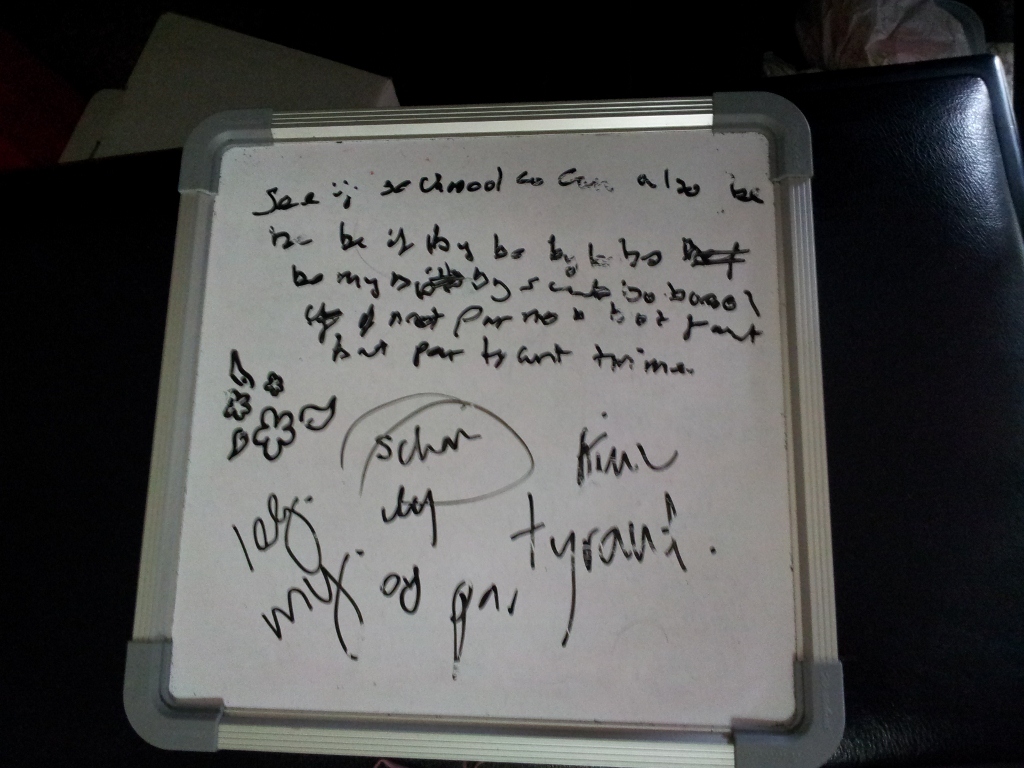
This is the last message Chang wrote to his family the weekend before he passed on (top 5 lines only). His handwriting was no longer legible. The bigger words below were the handwriting of his family who tried to decipher what he wrote but no one could make it out.


I visited Chang often starting from end August till September 11, the day he died. Initially, I thought of updating his blog every few days. Because of his condition, Chang left everything to me.  I suppose he was relieved that the blog was being updated at all. After seeing the number of viewers reading minutes after I posted an update, I felt the pressure. At first, I would visit him together with my husband after dinner but I realised that it might be a bit late for him and his family. So, I decided to drive to his house during lunchtime to check him out. We hardly spoke during those times because I did not want to tire him. I spoke mostly to his family to get updated on his medication, constipation problems and any new symptoms. The longest time we sat together was when I read him the readers' messages.

He spent most of the time with his eyes closed and requested for almost constant massage of his abdomen area.  It was obvious to me that he had read up and prepared himself for this end stage of his disease. Consistent with his character, he seemed to have everything under control.  He made arrangements with hospice, to borrow the hospital bed and other medical equipment. He also gave instructions on the administration of his  medication  and his needs until  the day he was unable to communicate. He would spray his lips with water when it was too dry. He asked for iced water and  watermelon, yoghurt or ice-cream because he felt so hot inside. There were times when he would ask when his next dose of morphine would be because he felt the pain but it was not time yet for the next dose. There was a silent understanding that this was a waiting period........ for the end. And  the deterioration towards the end was quite rapid.

I could see that he was mostly a considerate patient. There was no drama, no whining or shouting despite his pain. He just quietly went through the entire process. I admire him for that. The irony is that you see the beauty in a person in their toughest moments.

I inadvertently went through an intensive course in watching the dying process. It was almost surreal. Those visits were filled with mixed emotions.  Watching the terrible suffering a human being has to endure, I wished to help but felt helpless to do much. I was reminded of the fragility and vulnerability of my own human condition.  The very impermanence of my own life and my own fears.  Then, there was the sadness of losing a buddy but on the other hand, the wish that he could go swiftly so that he suffered less. I finally decided that the best I could do was to let him know that he was being supported by many and that his struggle had been a meaningful one, through the readers' messages.

I was already on my way to visit him that afternoon when I received a message from his wife. Chang had passed on.  As I looked upon his dead body, what I saw was a  physical shell. For those few minutes, it felt as though time had stood still. I felt peace, a great reverence and surrendering to life.

We take the business of life so seriously, struggling with our worries and our many neuroses. Have we ever wondered what it is all for? At the end of our lives, we have to surrender everything, our life, our ego, our possessions, our loved ones.. It became profoundly clear at that moment, that there is nothing so big a deal that we need to stress ourselves over, fight with each other over or cannot forgive. Life is precious. Chang fought to the very end to keep it. Treasure what we have, live fully and  be happy.

* *I hope you have enjoyed this 49th day series.

Wednesday, 31 October 2012

49th Day (Part Two of Three)

Beautiful Nepal

I met Chang again a year after after he had been diagnosed with cancer. It was a chance meeting when I was out for my weekend morning walk. He told me almost immediately that he had been diagnosed with cancer and was healing himself using The Gerson Therapy. He gave the impression of someone in control and doing remarkably well.

I felt that the all important question was how he was feeling inside. It is the person's mental and emotional wellbeing that really matters, apart from the physical treatment. Had he been coping well? Was he being supported? For example, we can have the best doctors but if we are feeling really miserable inside, would that not be cause for concern? We have been brought up to think that emotional health is not important. And many times, we do not know how to handle or help people in crises.

From my experience in counselling, I find that there are many lonely people out there, who want to be listened to and acknowledged but are not getting their needs met. What more a person diagnosed with cancer? Being diagnosed with cancer can be an alienating and traumatic experience. It is like having a bomb thrown into one's lap. How does that feel? Can we just pat this person on the back and say "You will be okay. No worries." and leave him to deal with it alone? Or do we find ways to help him deal with it?

He told me that he had lost touch with his emotional world since he started working. I felt sad to hear this because there has been so much literature written on the  role of emotions in diseases. I asked him to look into the emotional and spiritual aspects of healing.

After reading about the success of the Thai monk, Kittiyano Bhikkhu in using the Gerson therapy to treat cancer, I suggested that he, too incorporate meditation, yoga and breathing to complete his therapy.  I suppose if these practices had not been  habitual in healthier times, it would be even more difficult in times of crisis. Change is not a comfortable word for most people, not even when they are faced with a life threatening disease. That is how we human beings are, I suppose. We are creatures of habit. 

Chang said that even though he was willing to listen to opinions about his therapies, ultimately it was his choice to make. He said that people were not happy when he did not follow their advice. He also said that only people with cancer understood him when he talked about cancer pain. Maybe there is some truth in that hence the reason for the establishment of cancer support groups.

Chang already had an extra two and a half years of life. He had time to travel, forge closer ties with friends and family and learn some life lessons. And he had a chance to create his own path. He wanted to do things his way and he did. We can argue, what if ....he did not try HIFU? To me, the result would have been the same. If it wasn't HIFU, it would have been something else.  He was determined to change his destiny but he learned along the way that some things were just beyond his control. It was not meant to be.

(to be continued......finale Part 3 will be published on Friday)

Monday, 29 October 2012

49th Day (Part One of Three)


I was reminded that today is the 49th day since my friend, Chang's passing. Since some readers here were followers of Chang's blog, I thought it apt to share some memories of him today, as a mark of respect. For readers who are new, Chang battled cancer for 3 years and passed away on September 11. It is not easy writing about anyone, alive or deceased as there are sensitivities to be considered. Everyone remembers their loved one differently.  He was a man with imperfections like the rest of us. He wanted to live, like all of us do. And by sharing his story, hopefully we  learn to live better through his good examples as well as his mistakes. This is my account.

I met Chang when I was relatively new to the corporate world. I joined the company when he had just resigned. He was my mentor-colleague for a brief period. At that time, he was still studying for his professional accounting examinations. I found him to be approachable, helpful, knowledgeable in his work, capable and  a hands-on worker. We kept in touch over the years and later, had another opportunity to work together again, also for a brief period. This time, I was much more seasoned and he had already obtained his accounting qualification. He was a very focused person, he always seemed to know what to do and to be in control.  I also  realised during this period that his general approach was a highly stressful one. And he could work for hours non-stop. I could not keep up with his pace. I felt he was driven by the need to earn money and an interest in IT. He was also very thrifty.  He wanted to train up as a SAP consultant. But he never did.

I got to know him better during the cancer period. He said that I am willing to talk about many subjects that most people are not. At times, I would challenge his words or views when I felt it necessary to do so. I would not be a real friend otherwise. When he got lost in his fears that the cancer had overcome him, just because he lost 1 lb in weight, I would question the validity of his fearful thoughts.  I treated him like any other person, whether or not he suffered from cancer.

I respect him not for his capability or knowledge. It was his strength of will, his openness about the disease and his willingness to share his experience during the cancer period. Many people in his situation would have given up. Few men could soldier on the way he did, doing many things on his own. I think he shone during this period. His resourcefulness and tenacity were outstanding. That said, it is also a double edged sword. Our very strengths taken to the extreme, can turn into weaknesses if they are not used skillfully.. This is where, ideally, spirituality can come in to help balance things out. However, this can only happen if we have the awareness that we have over-done things or over-stressed ourselves. We are not machines, after all. And even machines break down eventually.

( to be continued.......49th Day Part Two will be posted on Wednesday, 31st October.)

Tuesday, 9 October 2012

The Precious Human Life

A week before Chang passed on, a mutual girlfriend made a remark that he must have been very disappointed at the outcome of his therapies, in particular the Gerson Therapy. That Chang put himself through such a tasteless Gersons Therapy diet yet it failed to shrink the tumours. 

It struck me then how very different we human beings view the same situation. Probably, because I had never heard Chang express his disappointment that I never saw it in such a light.  So, what is your point of view? Do you think that the Gerson Therapy was a failure?

In the early days, he was a very staunch supporter of the Gerson Therapy and was hopeful especially after the first few months when he saw some results. However, he also said that the Gerson Therapy would take between one and half to two years to work.After that, he would have to look into other alternative therapies. At that time, he combined the Gerson Therapy with TCM herbs from CA Care and urine therapy. But as I recall, he started looking shortly after he came back from Mexico. He went into LDN, which threw his sleep cycle out of whack, fungicide therapy and snake grass which caused alot of phlegm and he was coughing blood.

While he must have been disappointed (as anyone would) that the Gerson Therapy did not manage to cure his cancer, I dont think he was ever disappointed with the Gerson Therapy per se. In fact, he promoted it everywhere he went. 

Some quarters say the Gerson Therapy is outdated. He used to say that from reading the write-ups, this therapy and that therapy seems so effective but he has not met one single real life person who attests to a cure. I said, "Mr Chang, as a person who has done marketing and sales before, you should know that they will advertise successful cases but how many are unsuccessful, we wouldn't know." He said "There are so many therapies out there. Which to choose?" I reasoned that because we are different and have different body types and inclinations, different therapies work for different people. The tough part is choosing the right one.

The Gerson Therapy can be quite a regimented therapy with its 13 juices a day, no oil, no salt, no sugar and lots of potatoes and little rice with up to 6 coffee enemas a day.  And he was doing all the marketing, washing vegetables, cutting carrots, juicing, boiling coffee, etc alone. Not to mention, writing this blog and doing all the reading and research as well. He really did put himself through alot. Who has his kind of motivation and determination?  In a way, he was very fortunate that he had all along been a very healthy and strong man. He still had alot of energy and he could run around and was very independent.

I told my girlfriend that as yet, there is no known cure for cancer. What the Gerson Therapy did for him, as Chang himself said was to control the growth of the tumours. In cancer, having a therapy that is able to control tumour growth is very, very good already. It gave him the extra few years of life. But Chang was out to carve a path to cure himself so he combined various therapies.

I used to tell him that he had just switched jobs from IT consultant to alternative health therapist. Still a workhorse. He was also a perfectionist. In the early days, he followed the manual almost to a tee. Scouring the organic shops for brown rice mee hoon with zero sodium (salt) in it. Squeezing water from vegetables before juicing because he insisted that the Gerson Therapy does not allow water. Over time, he learned to take some shortcuts and to be more relaxed with the therapy. 

Chang told me that had it not been for cancer, he would have travelled to Singapore to work and focused on earning money. Cancer stopped him in his tracks to reflect on his life. I felt that his cancer journey was a learning curve for him in many ways. In his pre-cancer days, he would not have spent his money on organic foodstuff or drank vegetable juices.

Lets not take for granted the life we have. When we come close to losing it, see how hard we fight to keep it. We are willing to travel the world to find a cure, for that "extra" few years, days or even minutes of life, for that one extra breath.  Realise how precious our human life is.

Wake up each morning to see each new day as an  "extra" time or "bonus" time. The journey of our life really is to hold that precious time in our hands and use it wisely.  What is it that stirs our heart? What is it that gives life meaning? Know that we have the power to change our lives and live differently. Look through our "bucket" list and do what we long to accomplish in this lifetime. Most importantly, say what we mean to say to our loved ones. Don't wait.

Saturday, 6 October 2012

A Mother's Love

This blog was inspired by the journey of my friend, Chang, who valiantly fought for his life in cancer. He was determined to carve his own path and created a blog to document the many alternative therapies he tried. He passed away exactly three years to the day he was diagnosed.

Today, I decided to pay his mother a visit. Chang used to like buying her yamcake so I went searching for it but the stall sold only stuffed chee cheong fun today. I decided to get her some and a few paus for his father.

When I reached the house, she was pottering around at the front of the house, planting some ginger. We went in to talk and she dived straight into the conversation, reminiscing about her son. She started her story from the times before he went for the HIFU treatment in China. I know she tried very hard to be strong during his final days and even the days after he passed away. But today, she confessed that her heart is in knots. That she cries for him and thinks of him often. She is heartbroken.
 
We all grieve for his loss. Family and friends alike. But for a mother, the loss of a child is the most devastating loss. Though Chang spent more than 2 years preparing her for his death, which mother can accept the death of her child? No matter how one loses a child, whether by prolonged illness or sudden death, the loss of a child is perhaps the most profound, the most overwhelming, the most inconsolable of losses to deal with.

There are many reasons for this:-
It violates the natural order of things--your children are not supposed to die before you.
Your love for your child is unconditional and pure-perhaps the most profound of attachments you will ever have.
It evokes rage at the injustice of it all-- why should a good hearted person lose his potential and fail to see his dreams fulfilled?

Grief is a natural process we go through in order to heal. Though in some cultures due to strong religious practices, they say that grieving is not necessary. Instead they smile and celebrate a life well lived. Until we arrive at that stage, we will feel the pain of what we have lost. We are rudely awakened by the very impermanence of this world. Such is the reality of life.

We grieve for the loss of the close bond or connection, the mutual love and caring we derive from that relationship. We have come to depend on the presence of our loved one and feel lost without them. We feel the void left behind. This is because we have lost a source of either love, security, comfort or financial support, which was met by the deceased. We ache for this loss and it seems almost impossible to fill that void again. And at times, we feel too depressed to move on and to live again. However, we have to ask ourselves honestly whether our pain is because our loved one is now in a bad place or is it because we are crying for ourselves, losing the important source of love, comfort etc. 

Does our life revolve only around this person and is he/she the only one who meets our needs? Have we filled our lives with a circle of friends and family who can all provide for these needs in small measures? And most importantly, do we meet our own needs? Have we been that source of love and security for ourselves or have been relying on sources outside ourselves only? This would be the hardest of all, standing up for ourselves, loving and comforting ourselves. Giving to ourselves. No. I am not talking about selfishness. I am talking about unconditional love for ourselves.

The fact that some cultures are able to celebrate death suggests that there is an alternative way to view dying. What is life to you? Is death the end of everything? Or is the death we speak of merely the death of the physical container or body? Does your connection to your loved one disappear just by physical death? Or do you believe in more? For this is the time to draw on the strength of your beliefs and to transform that pain into something beautiful for you and your loved one.